There is a question I think a lot of business owners are asking quietly at the moment.
“If AI can write content, build ads, analyse data and give me ideas, do I still need an agency?”
It is a fair question.
I do not think clients are wrong for asking it. In fact, I think it would be strange if they were not asking it. AI can sound very convincing. You can ask it for a marketing strategy and, within seconds, it will give you something that looks structured, logical and professional. You can ask it for ad copy, blog topics, email campaigns, keyword ideas or landing page suggestions and it will rarely stare back at you blankly.
For a business owner looking at agency fees, internal salaries, rising costs and tighter margins, it is completely understandable to wonder what still needs to be done by people.
That is the honest starting point.
Marketing is changing quickly. The basic, repeatable parts of the job are becoming easier to produce. First drafts, initial research, campaign ideas, reporting summaries, content outlines and simple technical checks can now be created much faster than before.
Pretending otherwise would be naïve.
But changing is not the same as dying.
What AI has really done is expose the difference between output and outcome. It has made it much easier to produce something that looks like marketing. It has not made it easier to build trust, understand customers, make difficult trade-offs, position a business properly, manage budgets responsibly or turn activity into growth.
That is where the value now sits.
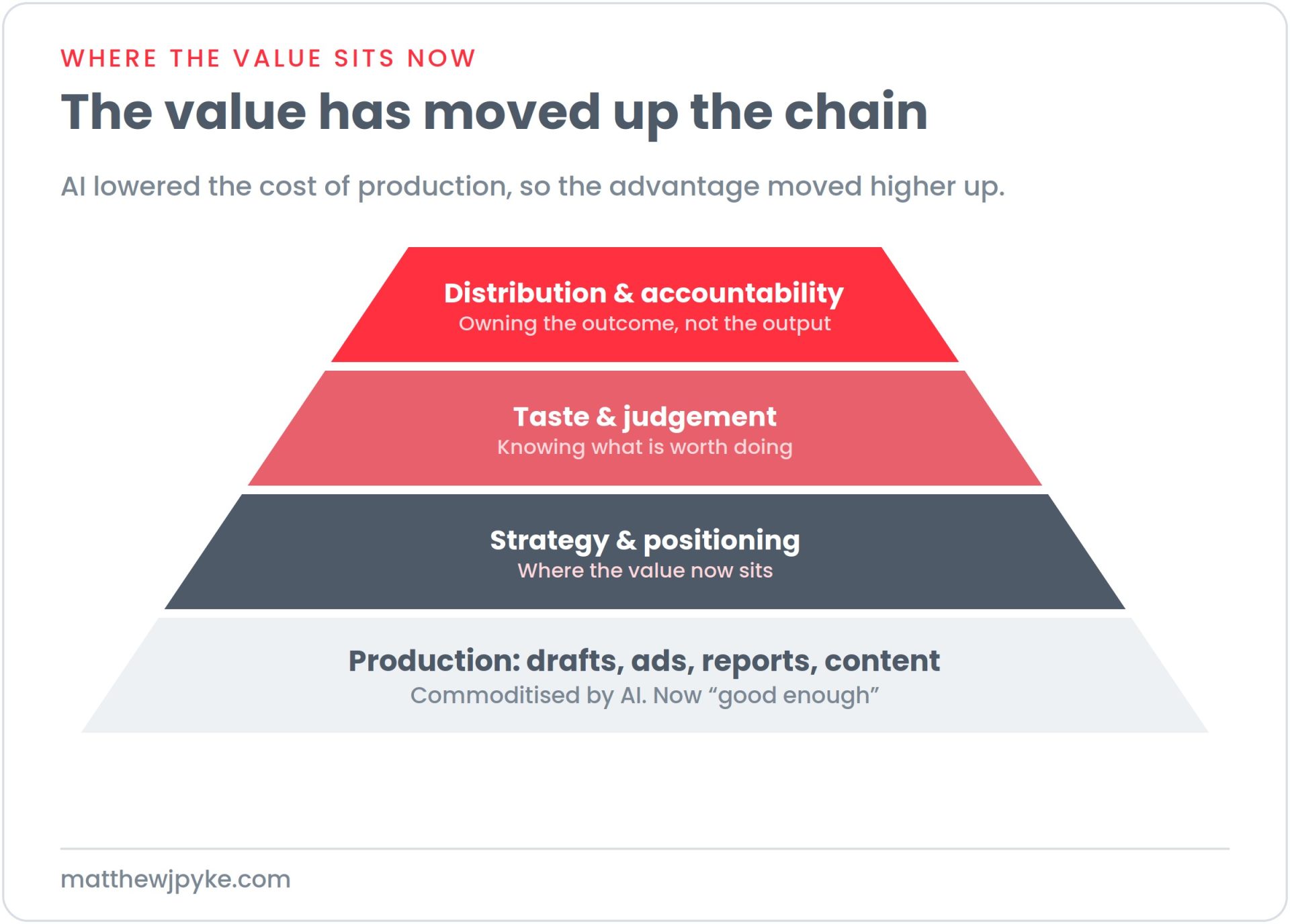
When everyone can produce something that looks “good enough”, good enough stops being enough. AI has lowered the cost of production, so the value has moved higher up the chain to strategy, judgement, taste, accountability and distribution.
The winners will not be the businesses with the most AI tools.
They will be the businesses that know where to point them.
The internet is full of average
The biggest change AI has created is not that content is easier to make. It is that average content is now everywhere.
You can see it in search results. You can see it on LinkedIn. You can see it in email campaigns. You can see it in blog posts that are technically fine but say very little. The words are clean, the headings make sense and the structure looks professional, but something is missing.
No real opinion. No lived experience. No commercial context. No sense that the person writing it has actually been in the room with a client, looked at the numbers, dealt with the pressure and had to make the call.
That is why the word “slop” has become part of the conversation around AI-generated content. It describes the flood of low-quality digital material being produced at scale. It does not mean all AI content is bad, and I do not believe AI itself is the problem. The problem is lazy use of AI. It is the temptation to mistake volume for value.
For years, businesses were told to produce more. More blog posts. More landing pages. More social posts. More email campaigns. More ads. More video scripts. More downloadable guides.
AI has made “more” easier.
But it has also made “more” less impressive.
If every competitor can publish at speed, publishing at speed is no longer the advantage. If every business can create a generic guide, generic guides stop working. If everyone has access to similar tools, the tool itself is not the thing that separates you.
The thinking does.
That is the part many people miss. AI has not removed the need for marketing expertise. It has removed the hiding place for weak marketing.
If the strategy was thin before, AI will not fix it. If the offer is unclear, AI will not magically make it strong. If the business does not understand its audience, AI will produce content based on assumptions. If the only plan is “publish more and hope traffic grows”, AI will simply help produce more noise.
The market is not short of content.
It is short of useful thinking.
Search is changing, but demand has not disappeared
This shift is especially clear in SEO.
For years, the model was relatively simple to explain. You researched what people searched for, created useful pages, improved the website, built authority, ranked higher, earned clicks and converted some of those clicks into enquiries or sales.
That still matters. The fundamentals of SEO have not vanished. Technical health, useful content, authority, trust, internal linking, page experience and conversion are still important.
But the search results page is changing.
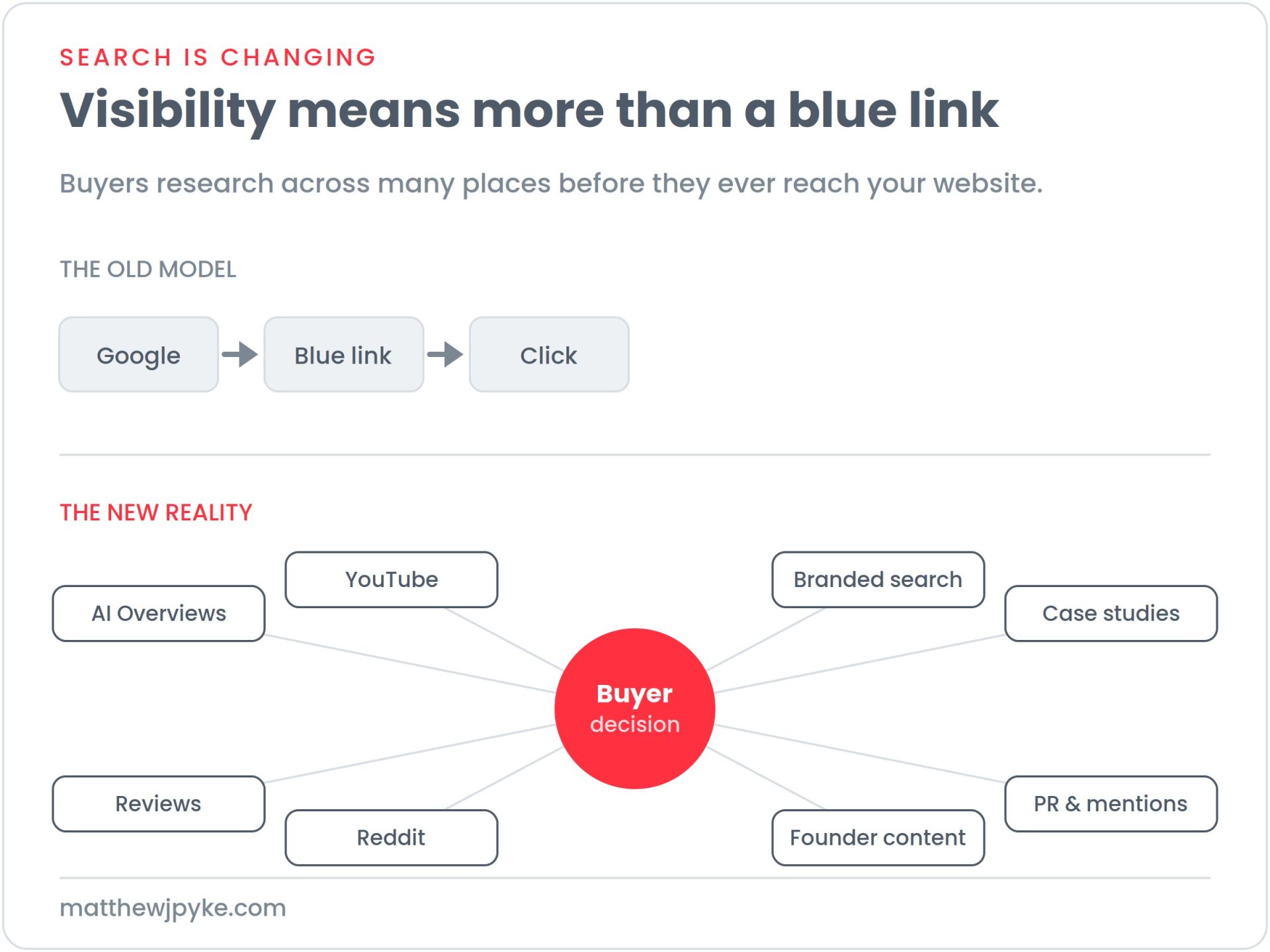
Google AI Overviews, answer boxes, featured snippets, Reddit threads, YouTube results, review platforms and AI tools have all changed how people find information. More answers are being given directly in the search results. More buyers are researching across different platforms before they ever land on a website. More journeys are happening without a neat, trackable click from Google to a service page.
This is where some people say “SEO is dead”.
I disagree.
Old SEO is under pressure. Lazy SEO is under pressure. SEO that only chases traffic without considering brand, trust or commercial intent is under pressure.
But search itself is not dead. People are still asking questions. They are still comparing providers. They are still looking for advice. They are still checking whether a company is credible before they spend money.
The difference is that visibility now means more than ranking a blue link.
It means being cited in AI answers. It means being visible in the places customers use to validate a decision. It means having a brand that people search for directly. It means having clear information across your website, your reviews, your social profiles, your PR, your founder content, your case studies and your wider online footprint.
The job has become more connected.
That makes it harder, not easier.
It is no longer enough to publish a page and hope Google sends traffic. Businesses need to think about how they are understood by people, search engines and AI systems at the same time.
That requires strategy. It requires experience. It requires judgement.
And it requires someone to decide what actually matters.
AI sounds convincing, which is why clients ask fair questions
One of the reasons AI has caused so much debate is because it is very good at sounding confident.
That is useful, but it can also be dangerous.
A business owner can ask AI for a marketing plan and receive a well-presented answer. It might include channel recommendations, campaign ideas, audience segments, content topics and budget suggestions. On the surface, it can look like something an agency would produce.
So I understand why clients ask questions.
They are not being difficult. They are not being disrespectful. They are looking at a tool that appears to do part of the job and trying to work out what they should still pay for.
The answer is not to dismiss the question. The answer is to explain the difference between information and judgement.
AI can give you options. It can help you think. It can summarise patterns. It can produce ideas. It can speed up research. It can create a starting point.
But it does not know your business like your leadership team does. It does not know the conversations your sales team are having. It does not know why a previous campaign failed unless you give it the full context. It does not understand the politics of a board meeting, the pressure of a quarterly target, the nuance of a brand, the quality of a lead or the real reason a customer chose one supplier over another.
It can sound right without being right.
That is why human judgement still matters.
The value is not in pretending AI cannot do anything. It clearly can. The value is in knowing where it helps, where it falls short and where a person with experience needs to make the call.
How good agencies actually use AI
At Fly High Media, we do use AI. I would be more concerned about an agency that said it did not.
But we do not use it as a replacement for thinking. We use it to improve how we work, speed up certain processes and create better systems behind the scenes.
For example, we have used AI to help create internal tools, including an onboarding platform that makes it easier to collect information, manage processes and give clients a smoother start. That is not about replacing people. It is about removing friction so the team can spend more time on the work that needs their attention.
We also use AI to help build custom scripts. These might support data analysis, reporting, internal checks or repetitive technical tasks that would otherwise take far longer manually. Again, the value is not that AI magically knows what to build. The value comes from knowing what problem needs solving in the first place.
Another practical use is during design sprints. AI can help us move quickly from an idea to early webpage mockups, wireframe concepts or content structures. That does not mean the first output is the final answer. It means we can test directions faster, challenge ideas earlier and get to a better starting point before designers, developers and strategists refine the work properly.
This is how I think agencies should be using AI.
Not as a shortcut for weak work.
As a way to make good people faster, sharper and more focused.
The same applies across SEO, PPC, content and strategy. AI can speed up research, group themes, summarise data, spot patterns and produce first drafts. But it still needs someone who knows what good looks like.
A tool can help create a report. It cannot decide what the client should do next quarter.
A tool can suggest ad copy. It cannot understand the full commercial risk of wasting budget on the wrong message.
A tool can help with content ideas. It cannot replace the experience of knowing which topics will attract the wrong traffic and which ones are more likely to influence the buyer.
That is the difference.
The 70% problem
One of the biggest mistakes businesses make with AI is assuming a good-looking first output is a finished piece of work.
In many cases, AI gets you 70% of the way there quickly. That is useful. It removes the blank page. It creates momentum. It gives you something to react to.
But the last 30% is where the results are usually won or lost.
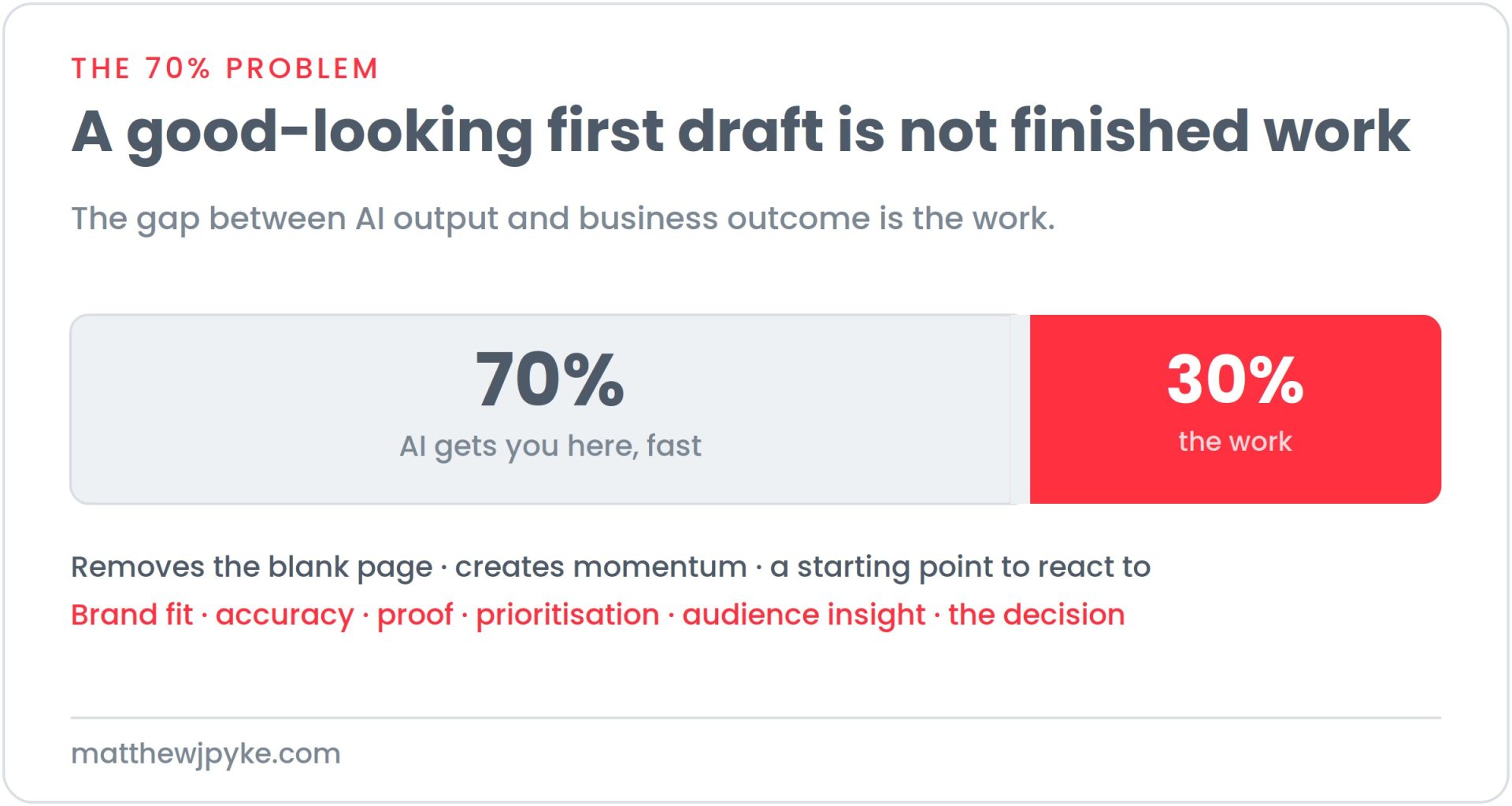
That final 30% includes the brand fit, commercial angle, accuracy, tone, proof, prioritisation, internal knowledge, audience insight and decision-making. It is the difference between content that fills a calendar and content that helps someone choose you. It is the difference between an ad that sounds nice and an ad that attracts the right enquiry. It is the difference between a report that explains what happened and a report that helps the business make a better decision.
This is where expertise becomes more important.
A junior marketer can now create a better first draft than they could a few years ago. That is a good thing. But someone still needs to review it, challenge it and connect it to the wider plan.
The gap between AI output and business outcome is the work.
And that gap is bigger than many people think.
AI amplifies whatever you give it
AI is a multiplier.
If you give it a clear strategy, strong data, good prompts, useful context and an experienced person guiding the process, it can be incredibly powerful.
If you give it a weak strategy, vague context and poor judgement, it can help you make mistakes faster.
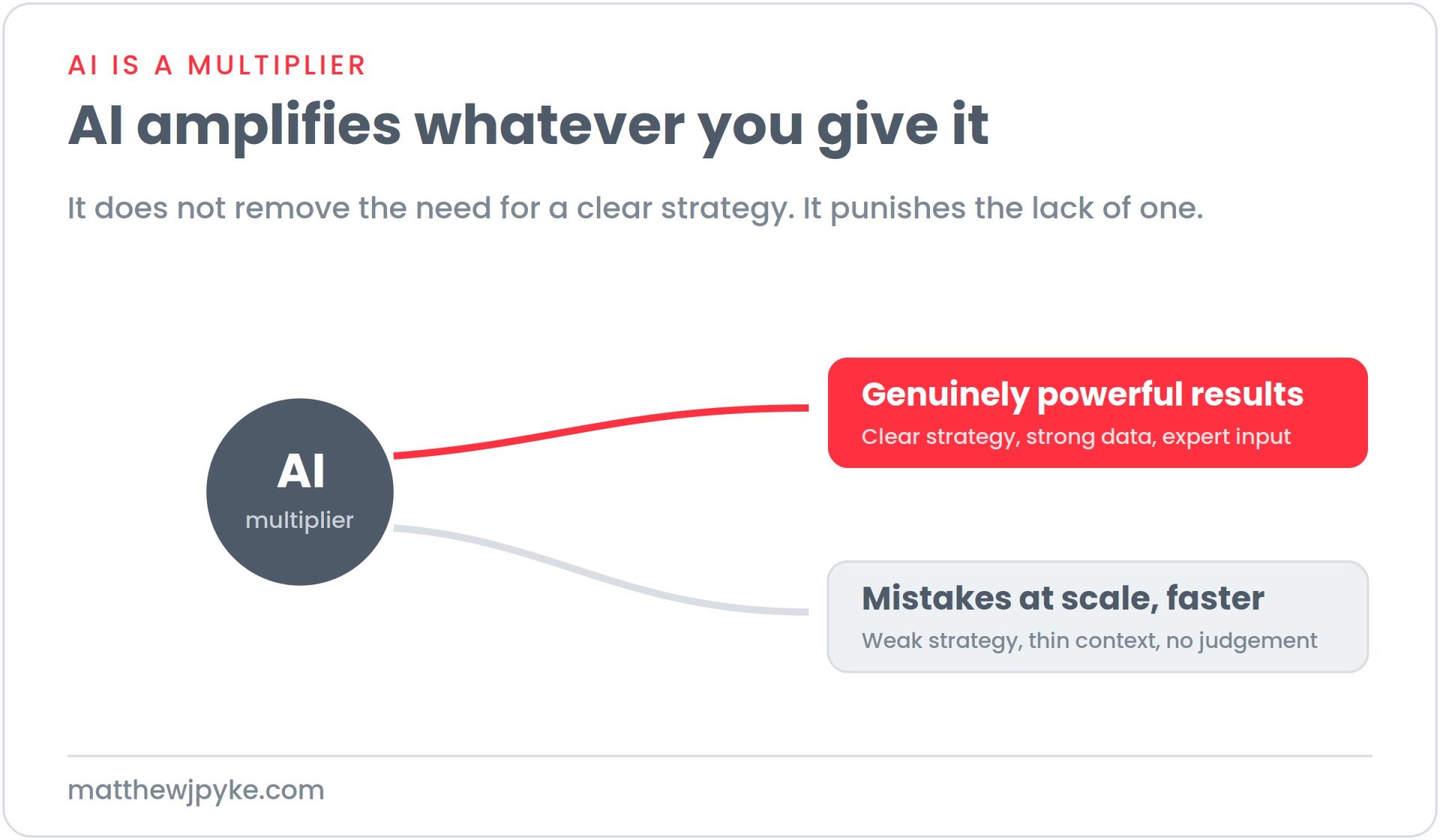
This is an important point for business owners. AI does not remove the need for a clear strategy. It punishes the lack of one.
If your positioning is unclear, AI can produce unclear messaging at scale. If your offer is too generic, AI can help you write more generic content. If your tracking is wrong, AI can help you make decisions from bad data. If your content plan targets the wrong intent, AI can help you publish more pages that bring traffic but not revenue.
The danger is not that AI produces nothing.
The danger is that it produces a lot of something that looks right.
That is why judgement matters. Someone has to decide what is worth doing, what is not worth doing and what needs to change. Someone has to understand the difference between activity and progress.
This has always been true in marketing, but AI has made it more obvious.
Deliverables are not the same as outcomes
Clients do not really pay agencies for blog posts, ads, audits, dashboards or reports.
They pay for progress.
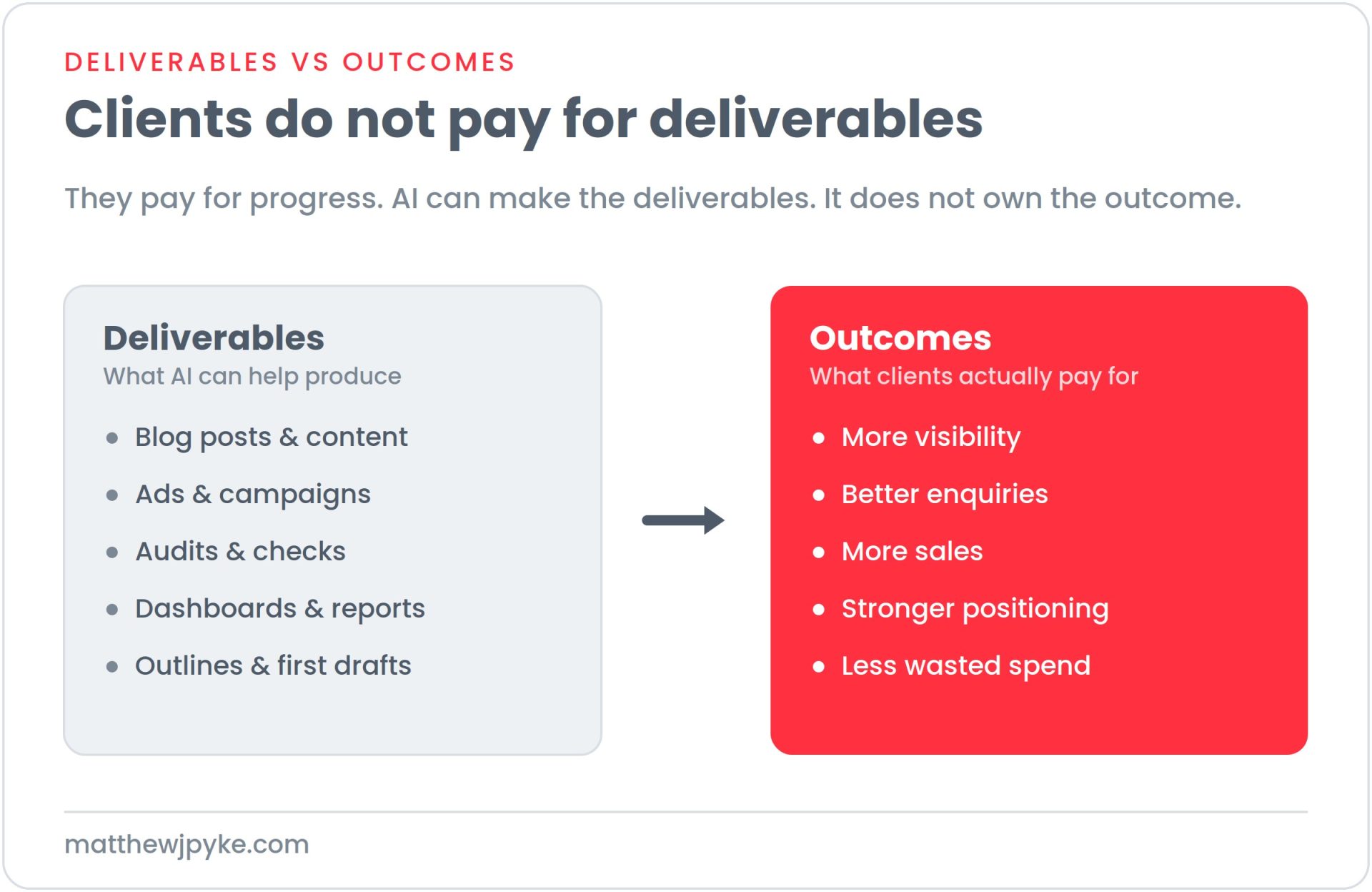
More visibility. Better enquiries. More sales. Stronger positioning. Clearer decision-making. Less wasted spend. More confidence in where the business is heading.
The deliverables are part of that, but they are not the end goal.
AI can help create deliverables. It can draft content, summarise data, suggest campaigns and build outlines. But it does not own the outcome. It does not sit in a client meeting and explain why leads have dropped. It does not speak to a sales team to understand why enquiries are not converting. It does not decide whether budget should move from one campaign to another. It does not take responsibility when a strategy needs changing.
People do that.
Good agencies do that.
Good in-house teams do that.
That accountability is valuable, especially when the market is moving quickly. It is easy to create more activity. It is much harder to know which activity is worth doing.
E-E-A-T matters more in an AI world
Google has spoken for years about experience, expertise, authoritativeness and trust. In an AI-heavy world, those things become even more important.
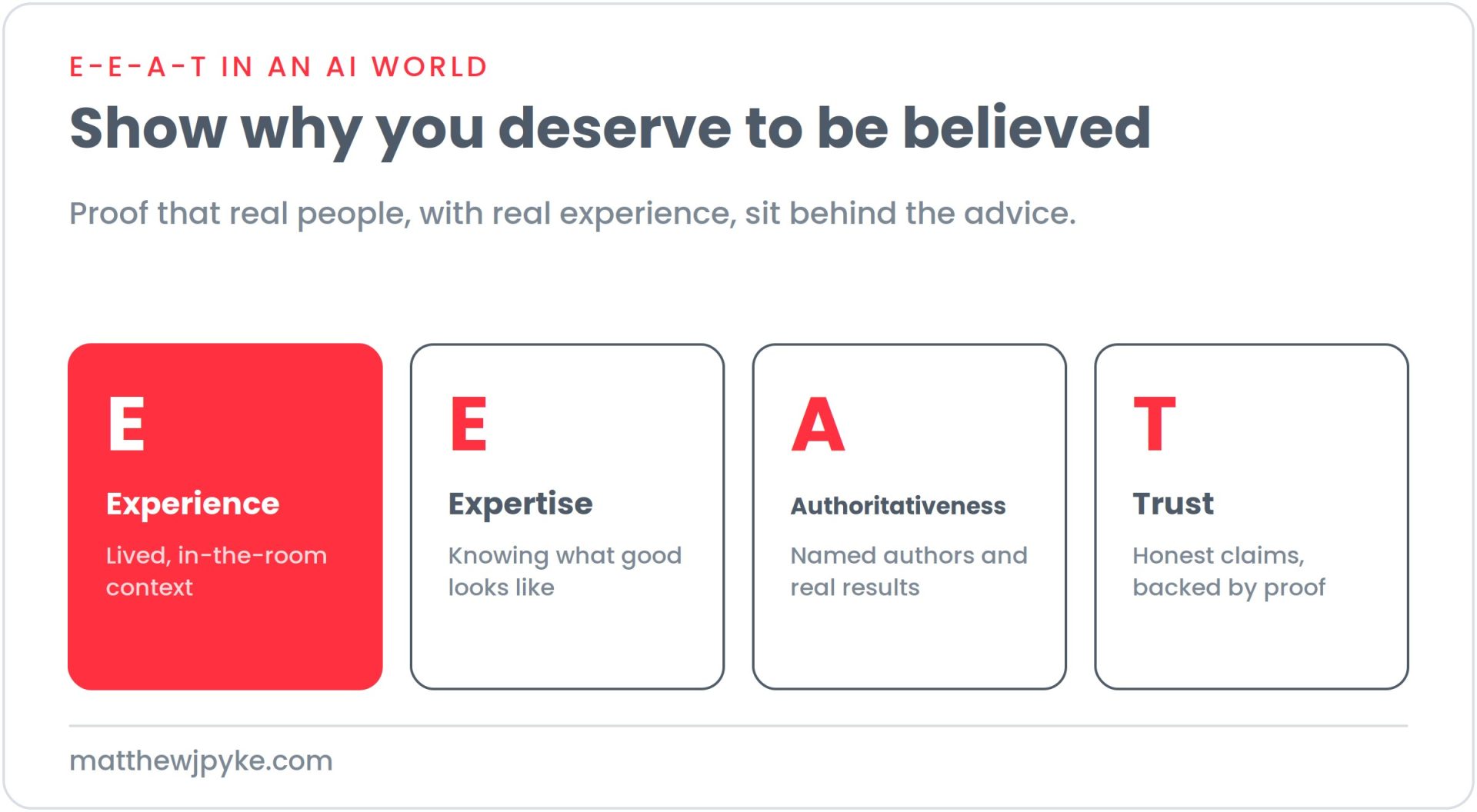
A business cannot afford to look like every other business. It needs proof that real people sit behind the advice. It needs evidence of experience. It needs content that shows judgement, not just information.
That means using named authors where it makes sense. It means adding original examples. It means showing case studies, client results, lessons learned and industry context. It means making claims carefully and backing them up. It means writing in a voice that sounds like a person who has actually done the work.
For me, that is where personal brand and business brand start to overlap.
On matthewjpyke.com, I do not want to write about marketing as a theory. I run an agency. I work with business owners. I see how SEO, PPC, content, websites and sales conversations connect. I also invest in my own digital assets, test ideas and build projects outside the agency.
That matters because it gives the content a point of view.
AI can summarise what others have said. It can help shape ideas. It can support production. But experience is what makes the content worth reading.
If a business wants to be trusted in search, AI answers and real buying journeys, it needs to show more than keywords. It needs to show why it deserves to be believed.
What winning looks like now
Winning in a world of AI noise does not mean rejecting AI.
It means using it properly.
For businesses, that starts with moving from content volume to content value. Publishing more is not a strategy by itself. The question should be: does this help the buyer make a better decision, trust us more or understand why we are the right fit?
It also means thinking beyond rankings. Ranking on Google still matters, but the bigger goal is visibility across the full decision journey. That includes being cited by AI tools, appearing in trusted third-party places, building a stronger review profile, increasing branded search demand and creating content that people remember.
Businesses also need to measure differently. Last-click reporting can be useful, but it does not show the whole journey. A prospect might first see your brand in an AI answer, then check reviews, then read a founder article, then watch a video, then search your brand, then convert through paid search. If you only look at the final click, you miss the influence of everything that came before it.
The businesses that adapt will ask better questions.
Are we being mentioned in the places our customers research?
Do we have strong enough proof online?
Are our reviews helping or hurting us?
Does our content sound like us?
Are we saying anything useful, or are we repeating what everyone else says?
Are we using AI to improve the work, or are we using it to avoid thinking?
That last question is probably the most important.
The real threat is standing still
I do not think AI will kill marketing agencies.
But I do think it will expose some of them.
It will expose agencies that only sold activity. It will expose teams that produced generic content. It will expose businesses that never had a clear strategy. It will expose anyone who relied on doing the same work in the same way for too long.
That might sound harsh, but I do not see it as a negative.
It raises the standard.
The agencies and marketers who win will be the ones who combine AI with commercial judgement. They will be faster, but not careless. They will use automation, but not at the expense of quality. They will understand tools, but they will not confuse tools with strategy.
For business owners, the question is not “do I still need marketing expertise?”
You do.
The better question is “is that expertise focused on the right things?”
Because in a world where everyone can produce something that sounds convincing, the real advantage is knowing what is true, what matters and what will actually move the business forward.
AI has made good enough available to everyone.
That is exactly why good enough is no longer good enough.