When leadership teams review budgets, the conversation usually lands in the same place. Where does the next pound go? Paid or organic?
PPC offers immediate visibility and predictable volume. SEO is often positioned as slower or harder to justify within quarterly reporting cycles.
On a short-term dashboard, PPC often looks like the safer choice. But when you extend the view beyond the next few quarters, SEO quietly becomes one of the most cost-efficient acquisition channels a business can build. The problem is not that SEO takes too long. It is that most organisations stop just before the economics flip.
To see the difference clearly, both channels need to be viewed through a commercial lens rather than a marketing one.
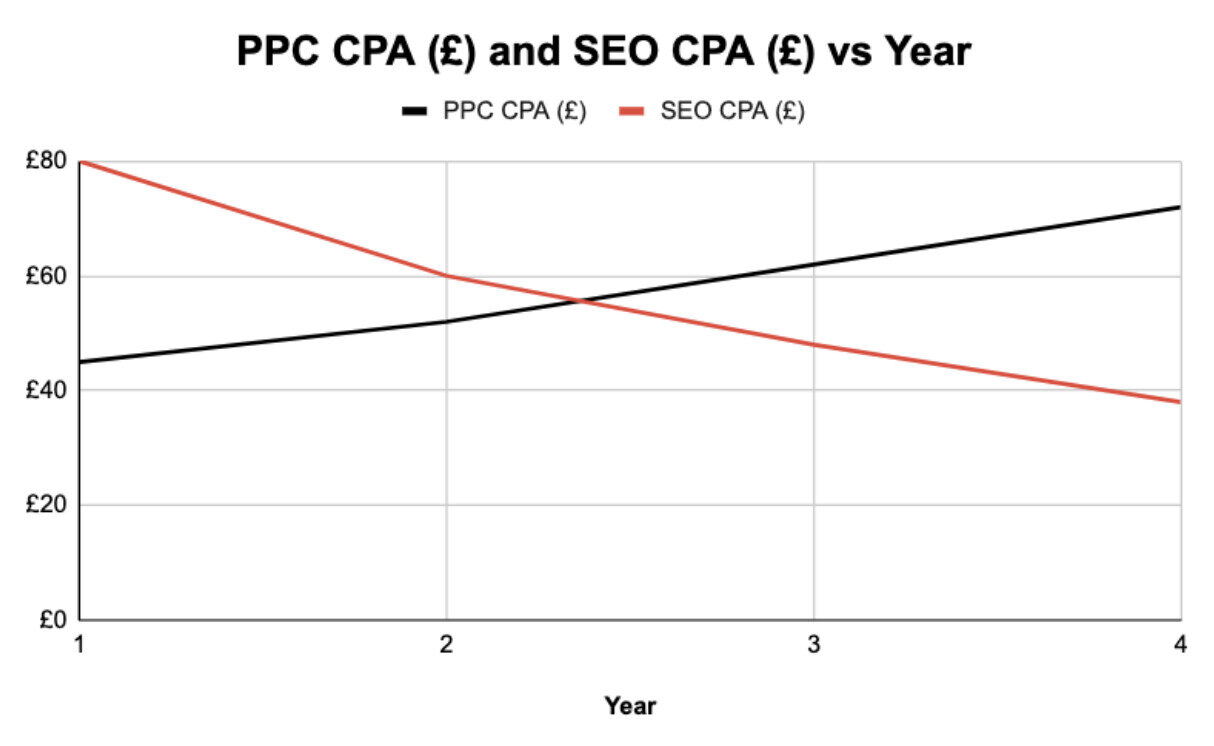
PPC costs rise. SEO costs fall.
A simple comparison makes this clear.
In year one, a PPC lead might cost around £45. That feels efficient and easy to defend. An SEO lead in year one might land closer to £80 as you invest in content, technical foundations and early visibility.
At first glance, PPC still appears cheaper. But PPC operates in an auction environment where costs rise as competition increases and platforms push monetisation. There is no compounding effect and no long-term protection.
SEO behaves differently. Early work continues to pay back, reducing acquisition costs over time.
A CPA view every CMO can use in the boardroom
Remove the channel labels and look at how costs actually move.
Year 1 CPA
PPC: £45
SEO: £80
This is often where discussions end. But year one is rarely the year that defines efficiency.
Now factor in normal auction inflation and organic momentum.
Year 2 CPA
PPC: £52
SEO: £60
Paid costs increase as competition tightens. Organic costs fall as rankings strengthen and traffic grows without proportional spend.
Extend the horizon again.
Year 3 CPA
PPC: £62
SEO: £48
At this point, SEO overtakes PPC on cost per acquisition, without requiring higher monthly investment.
Year 4 CPA
PPC: £72
SEO: £38
From here on, the gap widens. SEO continues to deliver even if spend levels stabilise. PPC stops the moment budgets pause.
A CFO once described it perfectly:
“PPC feels like paying rent. SEO feels like paying down a mortgage.”
That distinction matters when margins are under pressure.
Why PPC feels easier to defend internally
PPC fits neatly into governance models. Budgets are capped, CAC targets are clear and results appear quickly. There is less internal education required and fewer uncomfortable conversations.
But that certainty can be misleading.
You pay for every click
Costs rise as competitors respond
There is no lasting advantage
Paid media is transactional by nature. You are renting demand.
SEO requires earlier commitment, but it builds ownership. Investment goes into:
- Content that answers real demand
- Technical performance that supports scale
- Authority that compounds trust
- User experience that improves conversion
- This is not slow by default. It is cumulative.
Short-term thinking quietly erodes margin.
Many businesses reduce or pause SEO after a few months because returns are not yet obvious, while simultaneously accepting rising PPC costs as unavoidable.
I worked with a retailer spending heavily on paid shopping campaigns. CPAs increased every year, but the spend was tolerated because it delivered volume. Meanwhile, competitors invested steadily in organic search and gradually took ownership of high-intent queries that could not be bought outright.
Short-term reporting favours PPC. Long-term profitability rarely does.
Auction inflation is the unseen cost of paid media
In sectors like finance, retail, automotive, insurance and legal services, CPCs have risen consistently for years. When budgets tighten, advertisers bid harder to protect share, pushing costs up further.
There is no ceiling and no protection.
Organic search does not charge a premium for outperforming competitors. You do not pay more to rank higher. That absence of inflation is why organic traffic improves blended margins over time.
This is also why investors value it. Predictable organic demand supports EBITDA and strengthens valuations.
Customer lifetime value shifts the balance further
Assume a customer is worth £1,000 per year. A PPC CAC of £45 delivers strong returns initially. But as that cost rises to £62 or £72, margin tightens.
If SEO begins at £80 and delivers customers who stay for several years, the economics improve quickly. Organic buyers tend to convert more consistently, return more often and engage earlier in the decision process.
Paid media often captures intent at the end of the journey. SEO captures it throughout.
Brand search is the quiet return most teams miss
As organic visibility grows, more customers search directly for your brand. These searches convert at significantly higher rates and reduce reliance on generic paid terms.
You cannot rent brand recall. You have to earn it.
One CMO put it simply:
“Brand search is the return on work we did years earlier.”
That is SEO paying dividends.
How boards should really view PPC and SEO
They are not competing channels. They are different tools.
PPC is flexible, fast and short-term. It works well for:
- Launches
- Testing propositions
- Protecting immediate volume
- Time-sensitive demand
SEO is durable, efficient and defensive. It works best for:
- Reducing blended CAC
- Owning key categories
- Supporting long-term growth
- Building enterprise value
Commercially strong businesses do not choose between them. They sequence and rebalance them.
The real decision is not paid versus organic. It is time horizon.
In year one, PPC may look cheaper. By year three, SEO is usually doing more of the heavy lifting. That is when it stops being a cost line and starts behaving like a profit lever.
The strongest companies understand both. The smartest ones know when to shift the balance.
